Project
SWIFT Self-Checkout


Launched
Summary
DTEK.AI (formerly Dukkantek) set out to build a self-checkout experience for convenience stores that went beyond “scan & go.”
In most convenience stores, basket sizes are small, but lines are long, often because customers are also paying for Salik or mobile bills. Many abandon purchases because waiting for two items just isn’t worth it.
The ambition was simple in theory:
Grab your items → Place them on the counter → Pay → Leave
No scanning, no cashier, no queue, just a frictionless, AI-powered checkout.
This wasn’t just another barcode scanner. It was an ecosystem much complicated than that, combining:
AI-powered computer vision (learning thousands of SKUs)
Custom hardware (integrated cameras, counter, payment terminal)
Multi-level software for both end-users and internal ops teams
The brief: enable 3+ transactions per minute while keeping the experience intuitive for anyone, no explanations, no learning curve.
Goal
To increase transaction volume via SWIFT as a percentage of overall merchant sales, with a benchmark of 3+ transactions per minute. This demanded extreme speed, zero training, and an interface that worked for anyone, instantly.
My role
I led the end-to-end design lifecycle, from initial concept to post-launch optimization, across both customer-facing and internal-facing systems. My scope covered:
Hardware interaction design: taking part in optimizing the hardware's height and reach for accessibility.
Full UX/UI design: kiosk flows, payment interactions, AI feedback loops, and error recovery.
Internal efficiency tools: backend portal flows, B2B analytics dashboards, and operational tools for product training.
Feature prioritization: working closely with PMs, ML engineers, and ops to define the MVP and roadmap.
Design QA/QC: validating across multiple devices, languages, and store environments.
Understanding the ecosystem
The flow started far from the store. In our office, the ops team captured product photos from every possible angle. These were uploaded to our ML system, which trained the AI to detect products accurately in real time.
I collaborated with the ML team on image capturing guidelines defining camera angles, lighting, and orientation for optimal recognition, and translated these into the kiosk’s admin interface for store staff for the new SKU onboarding process.
Designing for three personas
SWIFT wasn’t just for customers:
End-users: Needed a fast, clear, intuitive checkout.
Store staff: Required admin access to train new products on-site and have control over transactions.
Internal ops: Needed portals for component integrations, monitoring performance, and system health.
Each persona had unique needs, and my role was to design flows and interfaces that served them without overcomplicating the system.
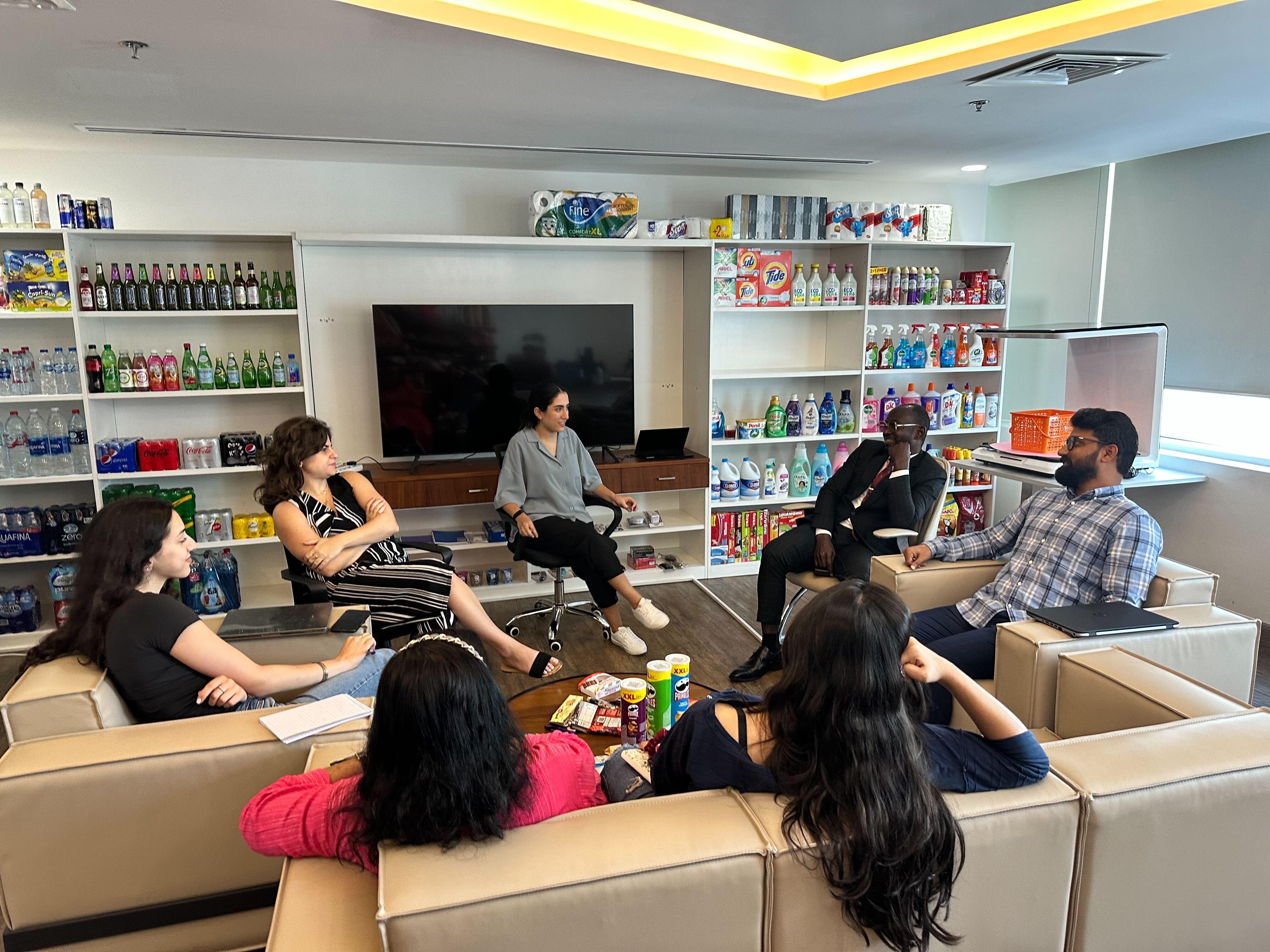
(Running a focus group to understand users' behaviour on digital interaction within the store)
Key Challenges & Solutions
1. AI recognition delay
Challenge: A 5-second gap between item placement and recognition risked making the system feel broken.
Solution: Introduced a “Start” micro-interaction to buy AI processing time and give users a sense of control.
2. Product training from the store
Challenge: Newly added products needed quick training without sending them to HQ.
Solution: Designed an Admin Access feature on kiosks, allowing store managers to capture item images directly from the device. The images were sent to the ML system without an intermediate review, reducing complexity and time.
3. Internal workflow efficiency
Challenge: The ops team’s manual product imaging and upload process risked bottlenecks.
Solution: Redesigned backend flows for batch uploads, clearer image guidelines, and better integration with ML tools.
4. Customer confusion during scanning
Challenge: Without a live camera view, customers didn’t know if the product is locked or can be replaced.
Solution: Added a live red status indicator on the kiosk to signal active detection, reducing abandoned checkouts.
Research & Validation
I conducted field studies in UAE stores, shadowing customers and store staff to capture behavioral insights. Competitive analysis covered retail tech in the US, EU, and GCC. We ran A/B tests for copy clarity, button placement, and fallback flows, prioritizing frictionless completion over aesthetics.
Results
Rolled out to 2 major ADNOC locations, with +2 other stores.
Achieved 3+ transactions/minute, reducing average queue time significantly.
Increased adoption rate among customers previously resistant to self-checkout.
Enabled real-time product training directly from stores, cutting turnaround time from days to hours.
Reflection
SWIFT was a constant exercise in balancing speed, accuracy, and operational feasibility. The biggest takeaway was the value of designing for the entire system, not just the end-user interface. Success depended on aligning AI constraints, retail workflows, and customer expectations without compromising transaction speed or accuracy.
This project reinforced my belief that in complex, multi-stakeholder products, design’s role is to remove friction across the entire journey, from internal operations to customer touchpoints, and to ensure every interaction, no matter who it’s for, drives measurable business outcomes.